Exposure & Large Format · Tool 06
Bellows Factor Calculator
About this calculator
The farther the lens is moved away from the film for a close-up, the more light is needed. With large-format photography, this additional extension quickly becomes significant. The bellows factor calculator uses the focal length and total extension to determine a time factor and an aperture correction.
If you already know the scale of the figure, you can use it directly in your calculations. It’s especially important to me to distinguish between the total and the additional section: Confusing the two at this point will result in a significantly incorrect correction.
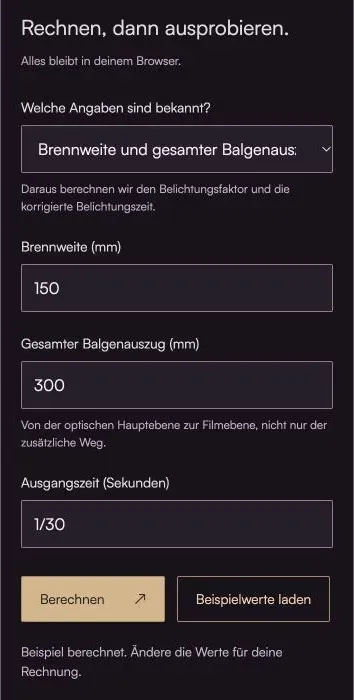
Do the math, then give it a try.
Everything stays in your browser.The calculator is loading …
Your result
100% / Select "Actual Size." Turn off headers and footers. Then check the 100-mm distance with a ruler.
How to Use the Calculator
- Select "Full Drawing" or "Scale" as your starting point.
- Enter the focal length and the total optical extension in the same unit. For the scale, 1 represents a 1:1 scale.
- Apply the factor to your measured time, or use the aperture correction provided.
What's Behind the Bill
Exposure factor = (Total extension / Focal length)² = (1 + Magnification)²
At infinity, the extension in the simplified model corresponds to the focal length. The factor is then one. With double the extension, it reaches four: You need four times as much time or two stops more light.
This relationship applies to a thin or approximately symmetrical lens. Measurements are taken optically from the image-side principal plane to the film plane. A measurement taken from the lens mount is a practical approximation whose accuracy depends on the design.
Internal-focusing macro lenses and asymmetrical designs may differ in their pupil scale. And if a TTL metering system already measures the actual amount of light, the correction must not be applied a second time. For an analog large-format camera with a separate light meter, however, the calculation process is easy to follow.
An example to work through
A 150-mm lens with a total extension of 300 mm results in a factor of 4 and +2 f-stops. Theoretically, 1/30 of a second becomes approximately 0.133 seconds.
Here's what you should keep in mind
- Only extensions starting at the focal length are provided for in this model.
- Filter factors and reciprocity are additional, separate corrections.
- The diagram is a sketch, not a dimensionally accurate construction drawing.
Frequently Asked Questions (FAQ)
How do I calculate the exposure factor based on the bellows extension?
Divide the total optical extension by the focal length and square the ratio. With a focal length of 150 mm and a total extension of 300 mm, the factor is 4, which corresponds to two stops more exposure. Multiply the measured initial time by this factor, provided the measurement has not yet accounted for the loss of light.
When referring to a "bellows extension," does that mean the total distance or just the additional length?
In this context, the “optical distance” refers to the total distance from the image-side principal plane of the lens to the film plane. In the simplified model, this distance corresponds to the focal length when the subject is at infinity. The additional extension is measured beyond that. An additional distance of 150 mm therefore results in a total extension of 300 mm for a 150-mm lens.
Do I need to make additional corrections when using TTL exposure metering?
If the TTL metering already accounts for the actual light loss caused by the setup you’re using, you must not add it again. This separate correction is particularly relevant when using external light meters. For specific camera, lens, or flash combinations, check what the metering system actually takes into account.
What do the scale ratios 1:2, 1:1, and 2:1 in the input field mean?
Enter the numerical reproduction ratio m: 1:2 equals 0.5; 1:1 equals 1; 2:1 equals 2. At 1:1, the image on the film or sensor is exactly the same size as the subject. In the symmetric lens model, this results in an exposure factor of 4.
Does the bellows factor also apply to modern macro lenses and long film exposures?
The formula is an approximation for thin or symmetrical lenses. Internal focusing and a different pupil scale may require different corrections. For long analog exposures, a film-specific reciprocity correction may also be necessary. The bellows factor alone does not account for this.
Read More & Sources
If you'd like to learn more about the basics, you'll find helpful explanations here.